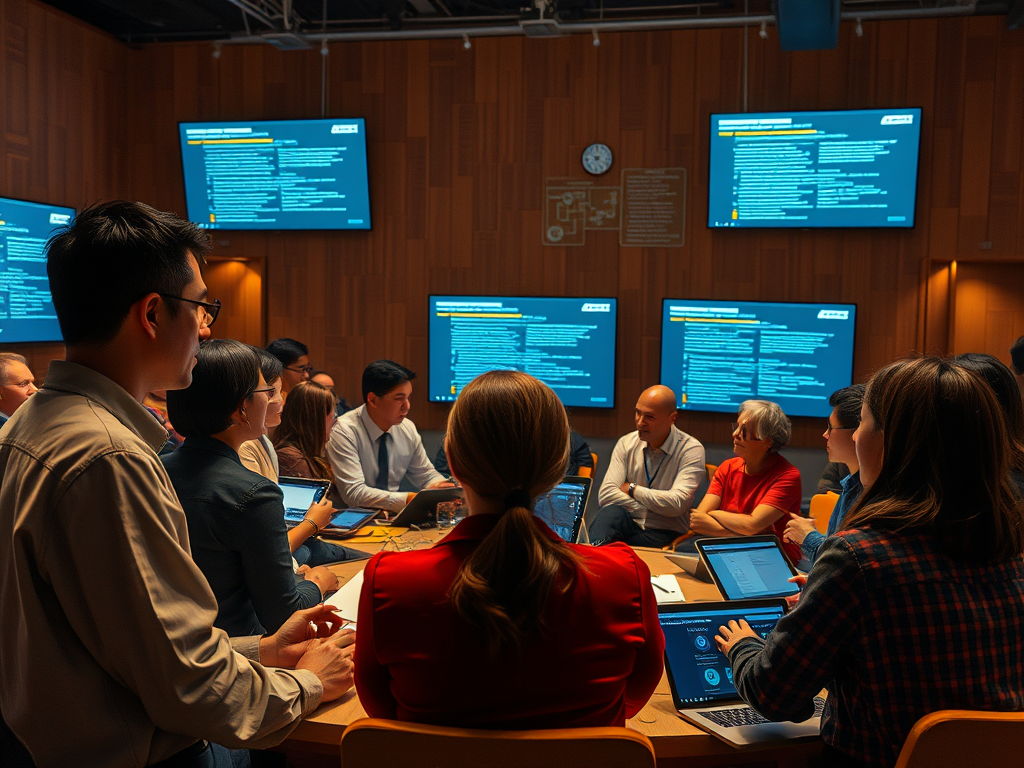
Topoi is not a chatbot. It is not an automated writing machine, nor an artificial “teacher” that replaces human judgment. Topoi is best understood as a collaborative intelligence platform—one designed to support thinking, writing, dialogue, and learning while keeping human agency firmly at the center.
At its core, Topoi is animated by a simple but often neglected insight: thinking is social, contextual, and rhetorical. Meaning does not emerge in isolation, nor does learning occur as a purely transactional exchange between a user and a machine. Instead, learning unfolds within communities, guided by shared purposes, shaped by roles, and constrained by norms. Topoi exists to make those structures explicit—and to let AI operate within them rather than above them.
From Chatbots to Contexts
Most contemporary AI systems are built around a one-to-one paradigm: a user issues a prompt, a model generates a response. While powerful, this structure flattens context. It treats every interaction as if it were independent, ahistorical, and socially neutral.
Topoi rejects this assumption.
Instead of focusing on isolated prompts, Topoi is organized around sessions—persistent conversational spaces that can involve multiple participants over time. These sessions are not merely chat logs; they are structured environments in which meaning accumulates, decisions matter, and prior exchanges shape future ones. In this sense, Topoi aligns more closely with a seminar room, a writing workshop, or a research group than with a question-answering engine.
By anchoring interaction in sessions, Topoi enables continuity, memory, and accountability—qualities essential to real intellectual work.
Human Roles, Not Artificial Authority
A defining feature of Topoi is its explicit recognition of human roles. Participants in a session may serve as leads, coordinators, contributors, peers, observers, or reviewers. Each role carries different permissions, responsibilities, and expectations.
Crucially, the AI itself is not cast as an authority figure. It does not “teach” in the traditional sense, nor does it unilaterally drive the conversation. Instead, the AI acts as a responsive collaborator—invoked deliberately, guided by human prompts, and constrained by human-defined goals.
This design reflects a deeply held conviction: education, reasoning, and judgment are normative human activities. They involve values, priorities, and interpretations that cannot—and should not—be outsourced to machines. Topoi therefore preserves space for disagreement, uncertainty, revision, and reflection, rather than optimizing solely for speed or fluency.
Prompts as Rhetorical Artifacts
In Topoi, prompts are not disposable inputs. They are treated as first-class artifacts—authored, revised, layered, and versioned over time. A prompt may originate at the organizational level, be refined for a specific session, and later be extended through targeted interventions.
This layered approach reflects a rhetorical understanding of communication. Prompts are shaped by audience, purpose, and situation. They carry assumptions. They frame inquiry. And they exert influence long after they are written.
By making prompts visible, reusable, and contextualized, Topoi encourages users to become more reflective about how they ask questions and structure inquiry. Prompt engineering, in this sense, is not a technical trick but a form of applied rhetoric—one that educators, writers, and leaders have practiced for centuries, now extended into human-AI collaboration.
AI as a Tool for Process, Not Product
One of the central tensions in contemporary AI use—especially in education—is the temptation to treat AI output as a finished product. Topoi is designed to resist that temptation.
The platform emphasizes process over product. AI responses are understood as provisional contributions: drafts, suggestions, counterpoints, summaries, or provocations. They are meant to be interrogated, revised, and situated within ongoing human work—not submitted wholesale as final answers.
This process-oriented design aligns with how real writing and thinking occur. Good ideas emerge through iteration. Arguments sharpen through dialogue. Understanding deepens through revision. Topoi supports these processes by making them visible and collaborative, rather than collapsing them into a single polished response.
Technical Architecture in Service of Pedagogy
Topoi’s technical architecture is intentionally aligned with its pedagogical goals. It is multi-tenant, role-aware, and API-driven, enabling organizations to define their own norms, access rules, and usage patterns. Sessions, users, prompts, and costs are all tracked explicitly—not to surveil, but to support transparency, sustainability, and informed decision-making.
Usage is metered and auditable, reinforcing the idea that AI is a shared resource rather than an infinite oracle. Model selection is abstracted, allowing different AI providers or local models to be used without redefining the human workflow. Streaming, real-time interaction, and multimodal extensions are treated as enhancements—not as replacements for thoughtful design.
In every case, the question is not “What can the model do?” but “What kind of human activity are we trying to support?”
Beyond the Classroom
While Topoi is deeply informed by educational practice—particularly writing instruction and collaborative learning—its vision extends well beyond formal classrooms. Any domain that depends on shared reasoning, guided inquiry, or collective sense-making can benefit from the Topoi approach: research teams, nonprofits, civic organizations, professional learning communities, and creative collectives.
In each of these contexts, the same principles apply: AI should amplify human judgment, not obscure it; collaboration should be structured, not accidental; and technology should serve values that are articulated, not assumed.
A Human Future with AI
At a moment when AI is often framed in terms of replacement, acceleration, or disruption, Topoi offers a different narrative. It imagines a future in which AI is domesticated rather than dominant—integrated into human practices without erasing their meaning.
This is not a nostalgic vision, nor a rejection of technological power. It is an assertion that intelligence is not merely computational, that learning is not merely efficient, and that writing is not merely generative. These are human activities, shaped by culture, ethics, and community.